Turn privacy and security reviews into a growth accelerator
TL;DR Most privacy and security review programs create friction because they start too late and rely on manual intake. The programs that work have two characteristics: they're proactive (reviews start early in the development lifecycle) and they're frictionless (intake is automated, AI handles triage, low-risk work auto-closes). One TerraTrue customer, Discogs, used this approach to cut vendor review time from 33 days to 4 — giving the business 29 more days per review to ship, without compromising risk coverage.
How to build a privacy and security review process that scales with your business:
The tension every privacy and security leader knows
Every modern business runs into the same contradiction.
On one side, there is relentless pressure to ship. New features, new vendors, new markets, new AI integrations. Every change the business makes introduces privacy or security risk, and very few things a company does today are completely risk-free.
On the other side, ignoring that risk carries real consequences. Regulatory fines. Data breaches. Reputational damage that takes years to repair.
The instinct in many companies is to pick a side. Either slow the business down until privacy and security have signed off on everything, or override the privacy and security team so engineering can move faster. Meta recently made headlines when engineers complained that privacy reviews were slowing launches, and the company responded by giving product teams more authority to release without human risk review.
Both approaches fail. One sacrifices growth. The other exposes the business to serious risk.
The third path is the one most privacy and security leaders are quietly searching for: an effective risk program that lets the business innovate at full speed while keeping risk in check. This guide breaks down what that actually looks like in practice — and how one company used it to cut vendor review time from 33 days to 4 days.
What is a privacy and security risk review?
A privacy and security risk review is a structured evaluation of a new product, feature, vendor, data flow, or business change to identify potential privacy, security, or AI risks before that change goes live.
Common trigger events for a review include:
- Launching a new product or feature
- Onboarding a new vendor or third-party service
- Sharing data with a business partner
- Entering a new market or regulatory jurisdiction
- Integrating a new AI tool or model
- Changing how data is collected, processed, or stored
Reviews typically involve privacy counsel, privacy engineers, security engineers, legal, and sometimes compliance. The goal is to identify unacceptable risks, propose mitigations, and document decisions for regulators and auditors.
Why traditional risk review processes break down
Most risk review programs were designed for a slower business environment. Today, with continuous deployment, dozens of active vendor relationships, and AI tools being adopted by every department, the volume of things that need review has exploded.
When risk reviews are manual, email-driven, and spreadsheet-tracked, predictable failure patterns emerge:
- Reviews start too late. Developers remember to loop in privacy or security the day before launch, leaving no time for meaningful feedback.
- Reviewers are bottlenecks. A handful of subject matter experts receive every incoming review, creating long queues regardless of risk level.
- Low-risk work consumes high-risk attention. Every launch gets the same heavyweight process, so genuinely risky work doesn't get the focus it needs.
- Documentation becomes a scramble. Records of Processing Activities (ROPAs), Data Protection Impact Assessments (DPIAs), and audit artifacts get reconstructed retroactively.
- Trust erodes. Developers start treating privacy and security as obstacles. Privacy and security teams start feeling ignored or overridden.
The result is the exact dynamic Meta publicly struggled with: a privacy function that the business resents, and a business that's one wrong launch away from a regulatory event.
The two ingredients of an effective risk program
An effective privacy and security risk program has two essential characteristics. Either one without the other fails.
Ingredient 1: Proactive reviews
Proactive means reviews start early in the development lifecycle — when the feedback from privacy and security experts is still actionable.
The worst time to start a review is the day before a product is scheduled to deploy. At that point, the privacy and security team has no meaningful way to influence design decisions, and any feedback they give translates into expensive rewrites or patches that the engineering team will resent.
Early reviews enable:
- Safer products by default. Design flaws get caught while they're still cheap to fix.
- Fewer rewrites and patches. Developers receive feedback when they can still act on it.
- Stronger trust between teams. Privacy and security become collaborators, not last-minute blockers.
This is what the industry calls shift-left — moving security and privacy considerations earlier in the development lifecycle, toward design and planning phases, rather than treating them as a final checkpoint.
Ingredient 2: Frictionless and scalable reviews
A proactive review program can still fail if it creates too much friction. If every developer has to stop their work, log into a separate tool, and fill out a 90-question form to initiate a review, the program becomes a tax on the business.
Scalability matters for a different reason: privacy and security subject matter experts are a finite resource. A program that requires manual expert review for every change will always be bottlenecked.
A frictionless, scalable program:
- Meets developers where they work. Intake happens automatically through Jira, Ironclad, or whatever system teams already use.
- Minimizes form-filling. Information gets pulled from existing documents rather than manually re-entered.
- Prioritizes expert time. Low-risk work gets auto-approved; experts focus on genuinely risky decisions.
- Integrates with downstream systems. Review outcomes flow back into contract workflows, engineering tickets, and compliance documentation.
When both ingredients are in place, a risk program stops being a bottleneck and starts being a growth accelerator.
Case study: From 33 days to 4 days
One TerraTrue customer — Discogs, the music discovery and record collecting platform — provides a concrete example of what happens when both ingredients are implemented together.
See the full Discogs case study → Discogs case study
The starting point
The company wasn't starting from scratch. They already had a privacy provider — a well-known compliance-focused platform — in place. Vendor reviews averaged 33 days. Assessments ran 90+ questions. Workflows were manual and email-heavy. The two-person privacy team had no real visibility into what was in progress across the business.
This is worth pausing on. A lot of privacy and security providers focus primarily on compliance: checklists, sign-offs, and documentation. Far fewer focus on being business-friendly in a way that gets reviews done effectively, early, and with actionable output. The distinction matters because a compliance-first approach can produce a technically compliant program that still bogs down the business.
What changed
The company implemented TerraTrue to manage vendor intake and privacy workflows. The implementation focused on three changes:
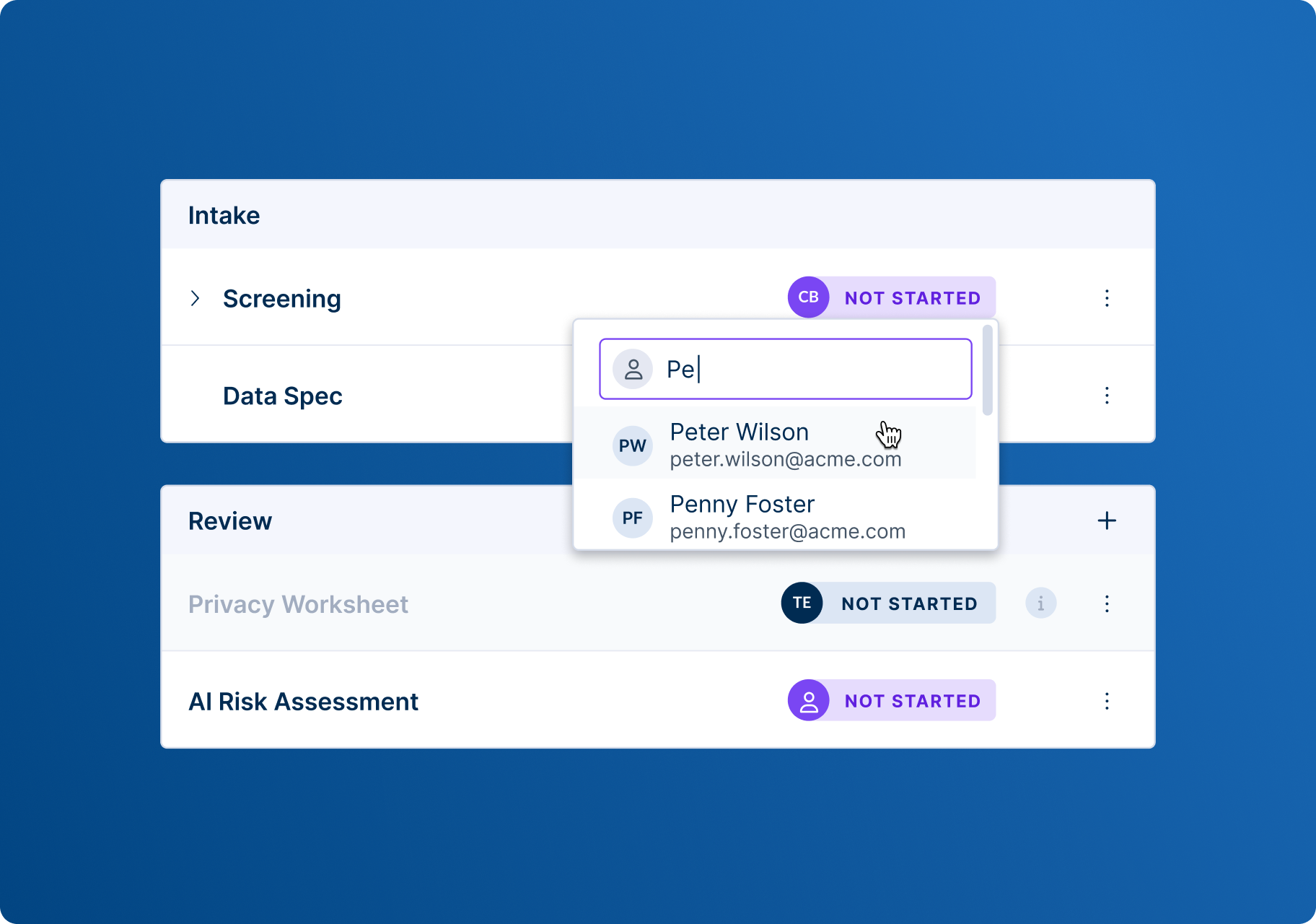
1. Automated intake through existing tools. Rather than requiring developers or business users to log into the tool and manually initiate reviews, integrations with Jira and Ironclad brought work into TerraTrue automatically. When a new contract came in about a new vendor, the right privacy and security reviews were triggered without any manual action.
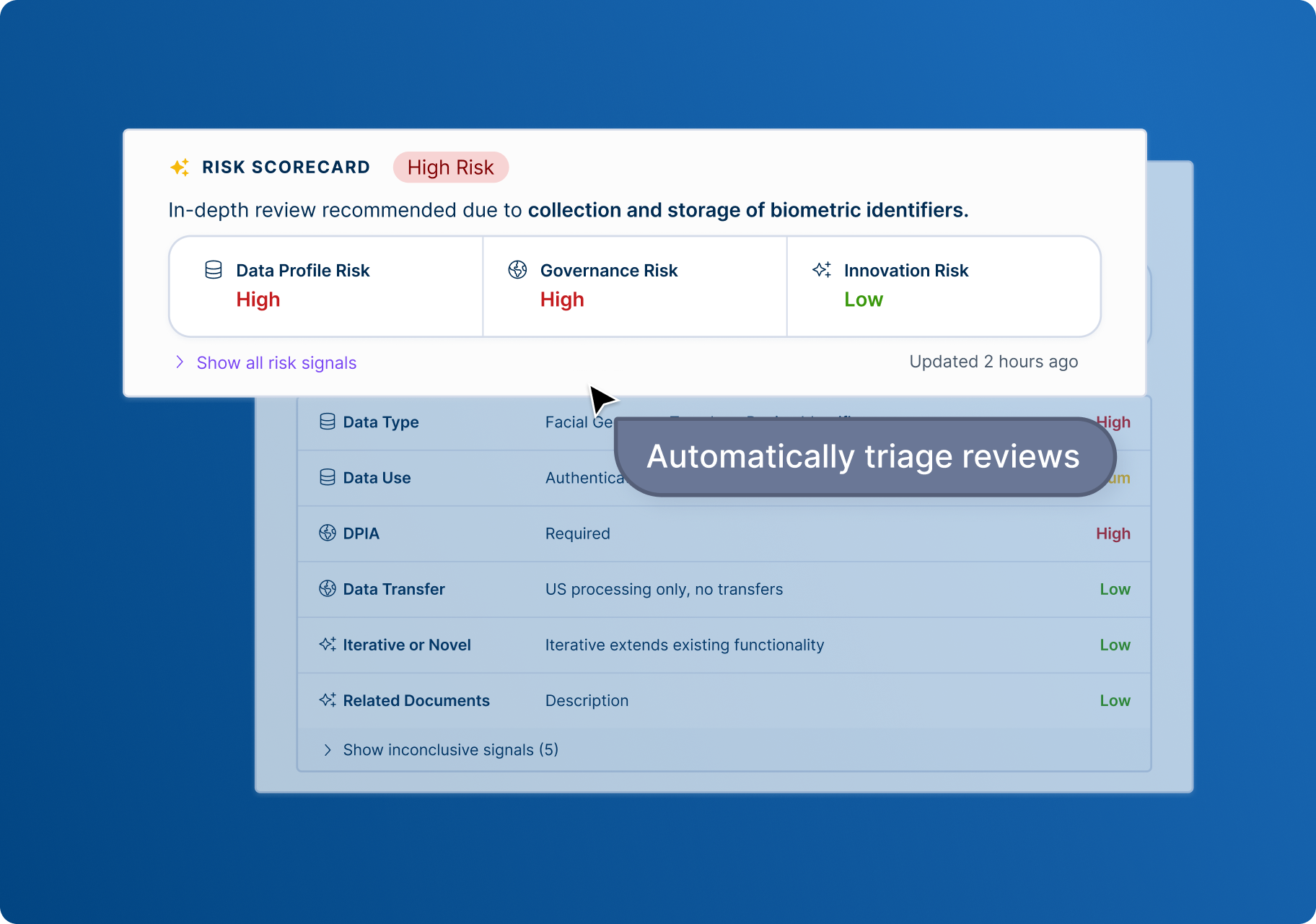
2. AI-powered triage. Instead of asking developers to fill out endless forms, TerraTrue's AI read the documents already attached to each launch — vendor security policies, SOC 2 reports, DPA agreements, design documents, PRDs — and automatically answered many of the review questions on behalf of the business.
3. Risk-based auto-closure. For low-risk work, TerraTrue could identify that no manual review was needed and close the review immediately. The business got instant feedback and could proceed. Experts stayed focused on the risks that genuinely needed attention.
The results
- Vendor review time: 33 days → 4 days.
- 29 additional days per review for the business to innovate, grow, and build new revenue.
- Employees can initiate launches on their own without chasing the privacy team.
- All 95 processing activities on the company's roadmap were on track for assessment completion.
- Fewer emails, more collaboration. The privacy team went from drowning in back-and-forth to running reviews as a coordinated process.
Beyond the time savings, the day-to-day experience of running the program changed. The team no longer felt overwhelmed by reviews piling up or the cognitive load of remembering context on 33-day-old threads. They could fire off a review, move to the next one, and trust the system to carry the context forward.
"We reduced our vendor review process timing because TerraTrue pulls all the stakeholders into one launch page that is easily accessible and gets the review going. Stakeholders clearly see a difference in how fast the review turnaround time is."
— Sam Moss, Privacy Program & Vendor Management Lead / Discogs
What to look for in a privacy and security review platform
For teams evaluating whether their current tooling supports a proactive, frictionless program — or considering a replacement — these are the capabilities that matter most.
Automated intake and discovery
Does the platform integrate with the systems developers already use (Jira, Ironclad, Salesforce, Slack)? Can it automatically trigger reviews based on signals from those systems, without requiring manual intake?
AI-assisted review
Can the platform read existing documentation — PRDs, design docs, vendor SOC 2 reports, DPA agreements — and pre-populate review answers? Does it understand context from prior reviews so experts aren't re-answering questions that were already resolved?
Risk-based triage
Can the platform distinguish high-risk work from low-risk work and route accordingly? Does it support automatic closure for work below a defined risk threshold, or does everything require manual attention?
Unified workflow for privacy, security, and AI
Are privacy reviews, security reviews, vendor assessments, and AI risk assessments all managed in the same platform — or does the team have to stitch together multiple tools?
Audit-ready documentation
Do reviews automatically generate the artifacts regulators and auditors expect? Records of Processing Activities, Data Protection Impact Assessments, AI impact assessments, and vendor risk records should be byproducts of the review process, not separate manual tasks.
Collaboration visibility
Can stakeholders see what's in progress, what's blocked, and what's been decided without sending status-check emails? Launch pages that consolidate context in one place reduce the cognitive load that tanks review program adoption.
How to start shifting your risk program left
For teams currently running a reactive, manual review program, the transition doesn't have to happen all at once. A practical sequence:
1. Instrument your intake. Before anything else, connect the systems developers already use to your review process. If you're not getting automatic signals from Jira, Ironclad, or your CRM, you're starting every review from behind.
2. Audit your review questions. If your assessments are 90+ questions long, cut them down. Questions that aren't actually used to make decisions are pure friction.
3. Define your risk threshold. Decide what "low-risk enough to auto-close" means for your organization. Without this, every review gets the same heavyweight treatment.
4. Consolidate tooling. If privacy, security, and vendor assessments live in separate systems, the team will burn hours reconciling them. A single source of truth changes the economics of the work.
5. Measure the right things. Track review turnaround time, auto-closure rate, and stakeholder satisfaction — not just the number of reviews completed. Completion rate without speed is still a bottleneck.
The takeaway
Privacy and security risks are not going away. A risk review process alone won't eliminate them — teams still have to build new defenses, respond to new regulations, and adapt to new threats.
But an effective risk program changes what's possible. It gives the business a strong starting point instead of a growing backlog. It makes the privacy and security team into partners rather than gatekeepers. And it turns the review process from a tax on innovation into a foundation for it.
If your current program looks more like the before picture in this case study than the after, the path forward is clear: proactive intake, frictionless workflows, and AI-assisted triage that frees your experts for the work that actually needs them.
About TerraTrue
TerraTrue is a risk and review management platform designed specifically for privacy, security, and AI risks. Customers across industries — from music and gaming to fintech and consumer apps — use TerraTrue to run proactive, frictionless review programs that scale with their business. Founded by former Google and Snap privacy and security leaders, TerraTrue is built for companies that refuse to choose between shipping fast and shipping safely.
Want to see how TerraTrue works? Book a demo.