Zero-touch TPRM: Automating vendor diligence from procurement to re-assessment
Third-party risk management often deteriorates into full-time administrative coordination. For most security, privacy, and legal teams, reviewing a new vendor doesn't begin with threat modeling or data privacy impact analysis. It begins with logistics: figuring out which vendor contact handles privacy versus security, debating which questionnaire matches their risk tier, sending emails, and setting calendar reminders to redo the entire process twelve months later.
When risk teams spend their days playing administrative traffic cop, review pipelines back up, business teams face procurement gridlock, and assessments become a one-time compliance rubber stamp rather than an ongoing safeguard. At TerraTrue, our platform enables AI Governance at Design-Time, and our vision is to build an autonomous risk program that eliminates administrative friction at every turn. Today, we are taking a major leap forward in Third-Party Risk Management (TPRM): introducing zero-touch automated assessment dispatch, risk-based dynamic evaluation, perpetual re-assessment scheduling, and intelligent contact routing.
The Friction in Traditional Vendor Diligence
Managing vendor risk traditionally suffers from three core bottlenecks:
- Manual, One-Size-Fits-All Outreach: Teams often dispatch identical, exhaustive questionnaires regardless of whether a vendor processes critical customer data or simply hosts an internal marketing blog. This creates vendor fatigue and unnecessary review delays.
- The "Primary Contact" Ambiguity Trap: Vendor outreach is frequently sent to a single catch-all account manager rather than the actual domain specialist. Privacy notices get lost in sales inboxes, while SOC 2 requests bounce between departments.
- Lapsed Re-Assessments: Vendor diligence is rarely evergreen. While teams intend to re-assess critical vendors annually or semi-annually, tracking re-assessments manually across hundreds of active vendors leads to missed deadlines and hidden compliance drift.
How It Works: Autonomous Vendor Risk Management
1. Dynamic, Risk-Calibrated Assessment Dispatch
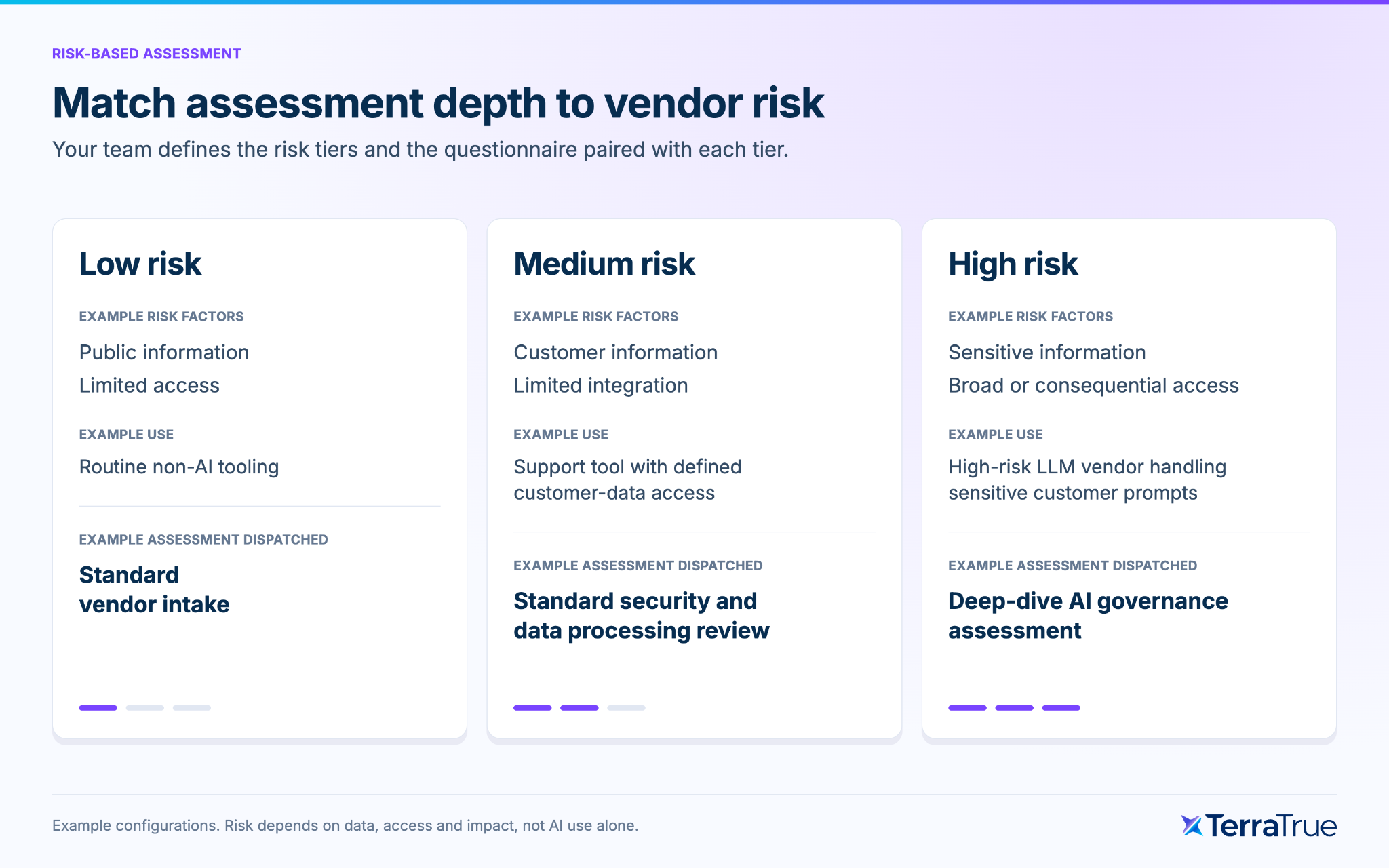
Not all third parties present the same exposure, and their assessments shouldn't either. TerraTrue now dynamically pairs assessment questionnaires directly with your predefined vendor risk tiers (Low, Medium, or High). When a launch is created, TerraTrue automatically evaluates the vendor's risk profile and dispatches the exact assessment required—from a standard vendor intake for routine, non-AI tooling, to a deep-dive AI governance assessment for a high-risk LLM vendor processing sensitive customer data. Furthermore, launch configurations now support automated CC lists (such as dedicated GRC distribution groups), ensuring compliance audit trails are preserved automatically without manual email forwarding.
2. Perpetual Diligence: Automated Re-Assessment Cadences
Vendor risk doesn't end when a contract is signed; software architectures evolve, certifications expire, and threat surfaces change. Previously, scheduling a recurring evaluation required manual tracking. Now, TerraTrue supports automated re-assessment triggers directly within your Launch Type configuration.
The moment an initial assessment is marked complete, TerraTrue automatically schedules the next review cycle—whether at 6 months, 1 year, 2 years, or 3 years. Reviews can spawn as standalone launches or linked child launches, keeping vendor history continuous and auditable without manual calendar upkeep.
3. Precision Role Routing & Intake Intelligence
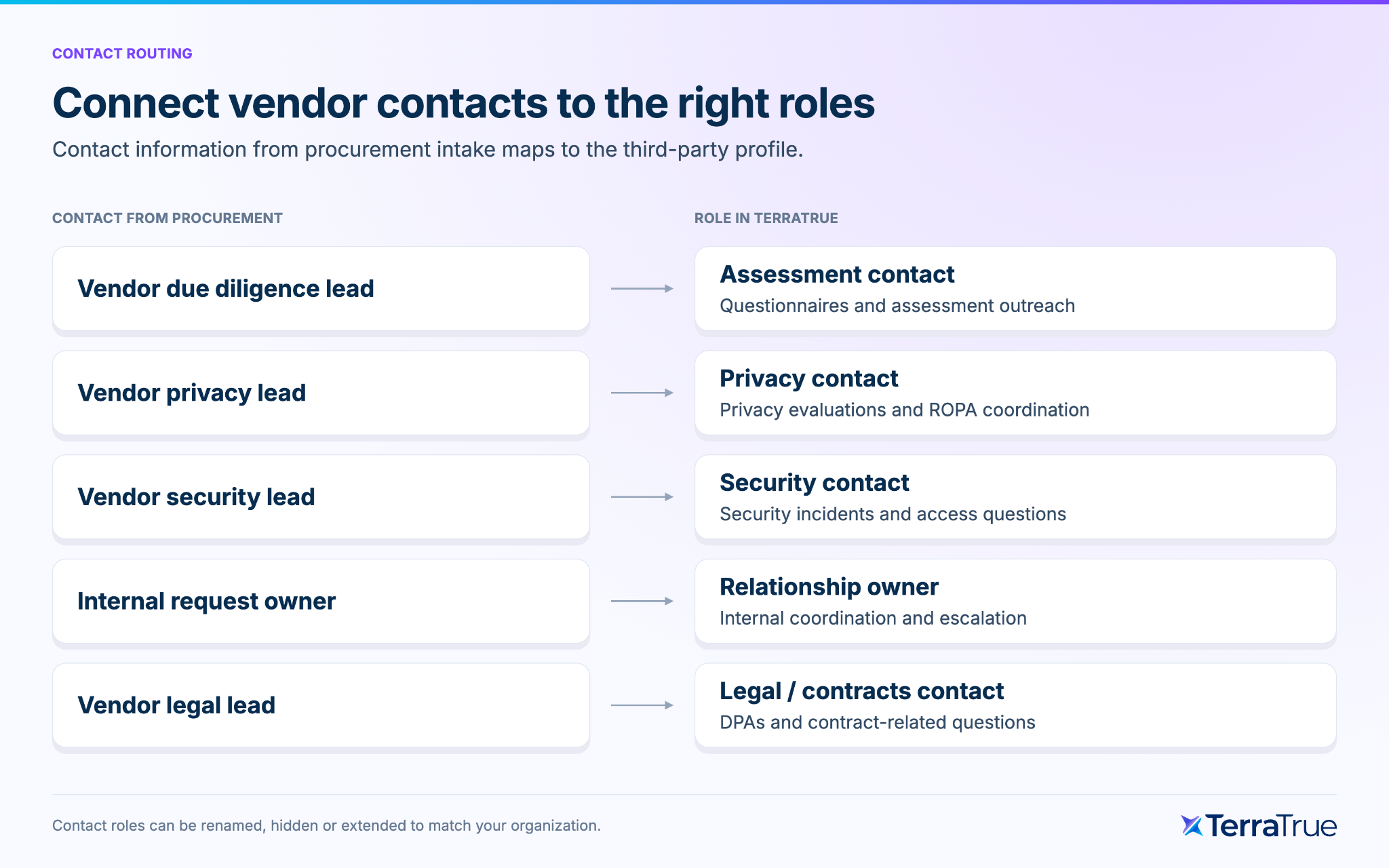
Generic contact directories lead to missed questionnaires. TerraTrue third-party profiles now support dedicated functional roles, ensuring communications reach the right subject matter experts immediately:
- Assessment Contact: Serves as the default recipient for due diligence questionnaires, certifications, and security reviews.
- Privacy Contact: Designated lead for privacy evaluations and automated synchronization with Records of Processing Activities (ROPA).
- Security Contact: Operational point of contact for incident workflows, access issues, and vulnerability disclosures.
- Relationship Owner & Legal/Contracts Contact: Dedicated points of escalation for contract renewals, DPAs, and overdue questionnaires.
Organizations can rename default roles, or define custom contact roles tailored to their internal governance taxonomy. To eliminate manual intake entry, TerraTrue also introduces automatic contact population from intake integrations, starting with Zip. When a procurement request initiates in Zip, TerraTrue parses the vendor payload and maps relevant contact fields directly to dedicated roles, eliminating dropped handoffs before diligence even begins.
4. Operational Control: Full Autonomy or Human-in-the-Loop
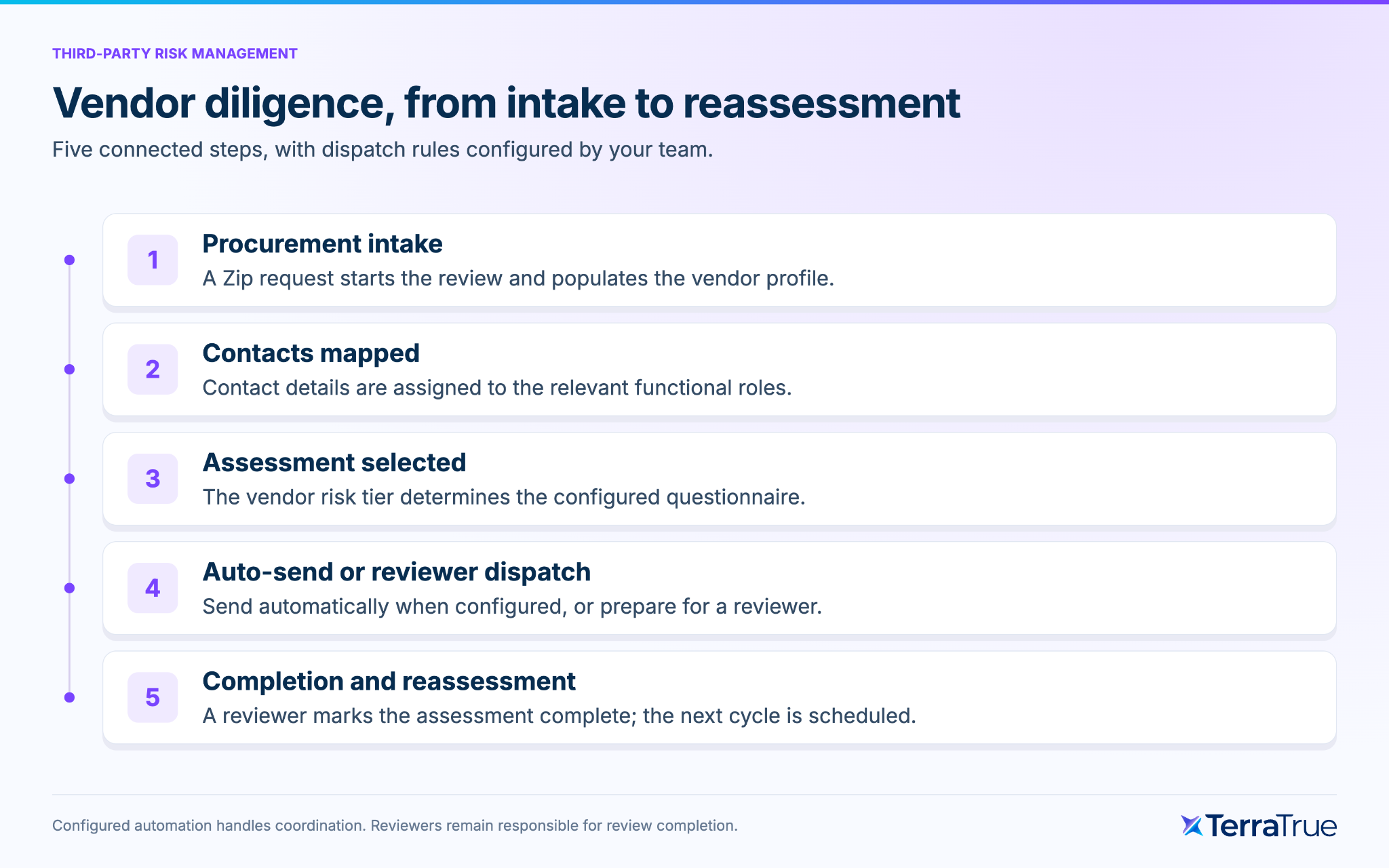
While automation speeds up workflows, control remains in your hands. Teams can choose between fully automated zero-touch dispatch or a prepared dispatch mode:
- Zero-Touch Auto-Send: When enabled, TerraTrue verifies the recipient configuration and immediately dispatches the assessment upon launch creation.
- Prepared Review: If auto-send is disabled—or if required contact details are missing—TerraTrue stages the prepared assessment directly on the launch summary with clear status indicators, enabling reviewers to verify details and dispatch with a single click.
Returning Risk Teams to What Matters
When risk reviews are automated at the operational layer, the entire organization benefits:
- For Review Teams: Eliminates repetitive email chasing, manual questionnaire selection, and spreadsheet tracking, freeing capacity for rigorous technical reviews and threat analysis.
- For Procurement & Business Teams: Vendor intake moves faster, handoffs from procurement tools like Zip are seamless, and review bottlenecks disappear.
- For Auditors & Regulators: Generates an unbroken, automated audit trail showing that every vendor was assessed proportionally to its risk profile and re-evaluated on schedule.
Autonomous governance isn't about removing human judgment—it's about removing the manual friction that prevents human judgment from operating at scale.