Vendor Breach Notifications: Know What Happened and What to Review Next
Your team approved a vendor. Months later, a breach disclosure raises new questions about the relationship.
Does the incident involve the service you use? What information does the vendor hold? Which previous assessment needs another look?
Learning about the incident is the first step. Finding the context to respond is the next.
TerraTrue’s vendor breach notifications bring incident information into a risk program where the vendor’s assessments and review history already exist. That gives teams a place to begin investigating what the event means for their organization.
How TerraTrue’s vendor breach notifications work
TerraTrue monitors vendors listed in your third-party risk management program, drawing on sources including state attorney general breach databases and regulatory enforcement trackers.
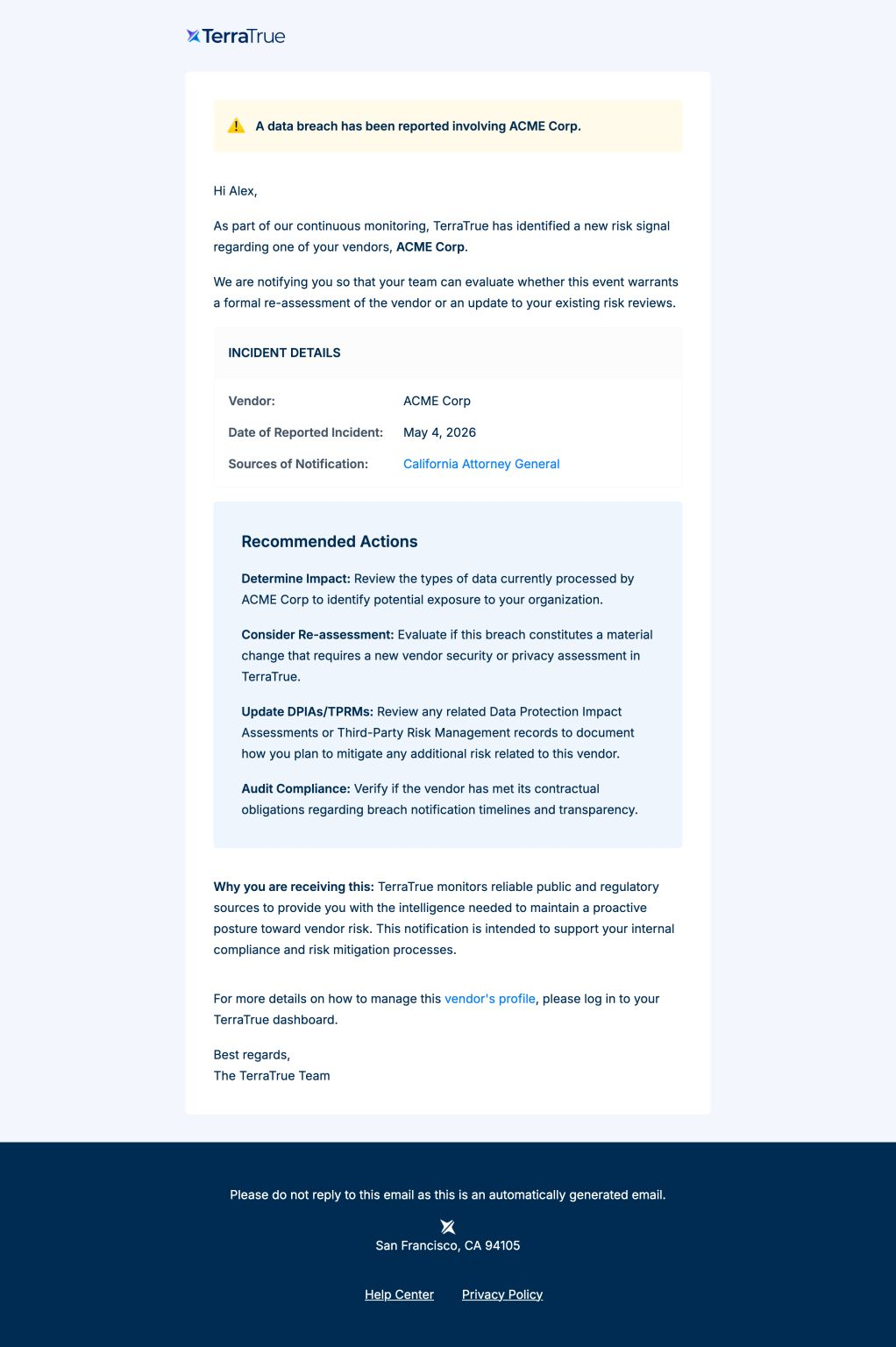
When a tracked vendor appears, TerraTrue sends a notification to your configured Slack or email destinations with the source, date, and recommended next steps.
Your team can then use the vendor’s existing assessments and review history to investigate potential exposure and decide what needs attention.
How do you know whether a vendor breach affects your organization?
Start by connecting the disclosure to your organization’s relationship with the vendor. Use your existing vendor records to answer:
- Which service does the vendor provide?
- Which teams or products use it?
- What data does the vendor receive or retain?
- What systems can it access?
- What conditions were attached to its approval?
TerraTrue’s third-party profiles bring together vendor ownership, data shared, risk scores, documents, and review history. That context helps reviewers identify what to investigate and who to involve.
Compare those records with the incident details and confirm current use with the business owner. An earlier assessment provides a starting point; the investigation establishes whether your organization was affected.
Use recorded data relationships to focus the investigation
A provider may support several products or business units. Different teams may share different information through it.
Reviewers need to distinguish those relationships before drawing conclusions about exposure.
Privacy Central lets teams examine recorded connections between vendors, products, data types, and related reviews. TerraTrue’s help documentation specifically describes investigating a vendor breach as a use case. See how Privacy Central supports incident investigation.
This context helps frame the questions. The vendor’s findings and your internal investigation establish which relationships were affected.
What follow-up could look like
Consider a hypothetical support provider named in a breach disclosure.
The response owner checks the existing assessment and finds that the provider handles customer support tickets. The team then needs to determine whether the incident involves the ticket environment, whether attachments are affected, and whether connected credentials need attention.
The reviewer can use the existing record to prepare a focused request:
- Confirm whether the affected service matches the organization’s use.
- Check whether recorded data sharing reflects current practice.
- Identify which commitments or controls need verification.
- Record missing information and the owner responsible for obtaining it.
- Determine whether an assessment or other record needs updating.
The earlier diligence provides a starting point. New evidence determines the action.
For a broader checklist covering exposure, containment, and notification decisions, see What to Do When a Vendor Has a Data Breach.
Scheduled reviews and incident follow-up serve different needs
Routine vendor diligence helps establish what a relationship involves and when it should be reviewed again.
An incident introduces information that may require attention sooner.
For example, a vendor’s next assessment may be scheduled for several months away. A disclosure suggesting exposure of information it processes warrants investigation now. The team can decide whether the findings require an earlier reassessment, remediation, or other action.
Our article Zero-Touch TPRM: Automating Vendor Diligence from Procurement to Re-Assessment explains the operational foundation: configured assessment selection, contact routing, dispatch, and recurring review schedules.
Vendor breach notifications complement that foundation by drawing attention to new incident information between review cycles.
Make responsibility clear after the notification arrives
Decide who receives notifications and who coordinates follow-up. That owner should be able to involve the business team, Security, Legal, and other specialists.
Track confirmed facts separately from unresolved questions. Give each material question an owner and an expected update date.
Depending on the evidence, follow-up might lead to a documented conclusion that another service was affected, a request for remediation, or revised conditions for continued use.
The important outcome is a recorded decision supported by the available facts.
Keep vendor review work useful after approval
The original assessment records what your organization understood when it approved a vendor. Its value continues when teams can return to that reasoning as circumstances change.
TerraTrue’s vendor breach notifications help teams learn about relevant incidents. Existing vendor records and assessments provide context for deciding what to investigate and review next.
See how monitoring and vendor review history work together in your risk program. Book a demo.