


What to Do When a Vendor Has a Data Breach
A vendor your company uses has reported a data breach. Did it affect your information? Should you restrict access? Who needs to investigate?
The announcement may provide a company name and a short incident summary. Your team still needs to determine what it means for your organization.
Start by confirming the affected service, identifying the information and access potentially involved, and assigning a response owner. Use existing vendor records to guide the investigation, then verify that they reflect how the service is used today.
Vendor breach response: where to start
A useful response connects the external event to your organization’s relationship with the vendor.
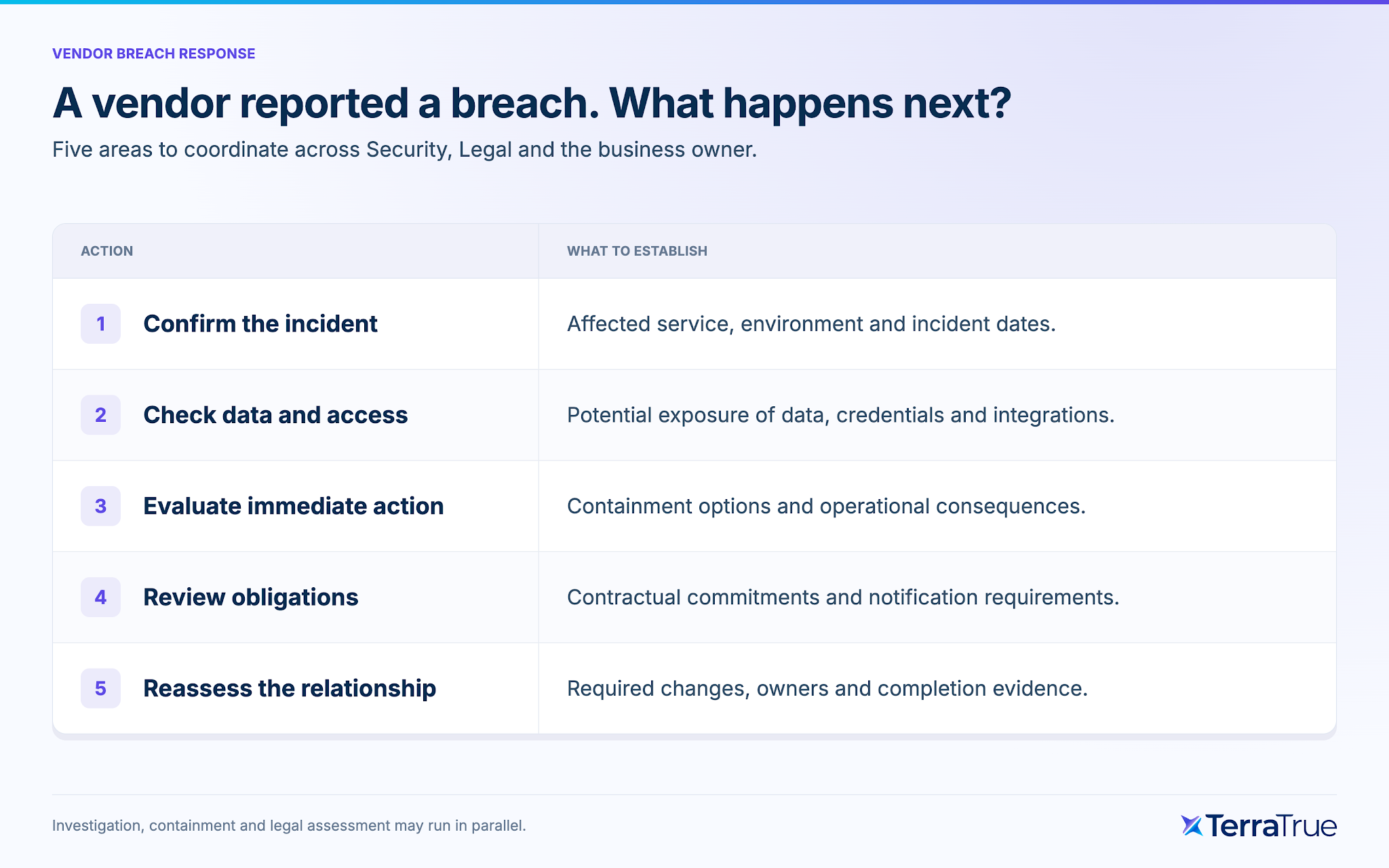
Five areas need attention:
- Confirm the incident and affected service.
- Investigate potential data and access exposure.
- Evaluate immediate containment measures.
- Review contractual and legal obligations.
- Reassess the relationship using the findings.
These activities may overlap. An urgent access issue should not wait for a completed reassessment, and Legal may need to evaluate obligations while the investigation continues.
Does a vendor breach mean your company’s data was affected?
Not necessarily. A disclosure may involve another product, environment, subsidiary, or group of customers.
Ask the vendor to identify the affected service, incident period, and customer population. Request confirmation of your organization’s status and the evidence supporting that conclusion.
Preserve the original disclosure and subsequent updates. Distinguish confirmed findings from preliminary statements.
If the vendor is still investigating, keep your exposure question open. Assign someone to follow up and record when the next update is expected.
What information and access should you check?
Compare the incident with what your organization shares with the vendor and what the service can reach.
Look beyond the primary application. Support attachments, exports, integration credentials, and retained historical records may also be relevant.
Check four areas:
- Customer data: account records, support tickets, attachments, and other information processed through the service.
- Credentials: API keys, tokens, passwords, and service accounts.
- Integrations: connected applications, permissions, and access to internal systems.
- Retained records: backups, exports, logs, and historical files.
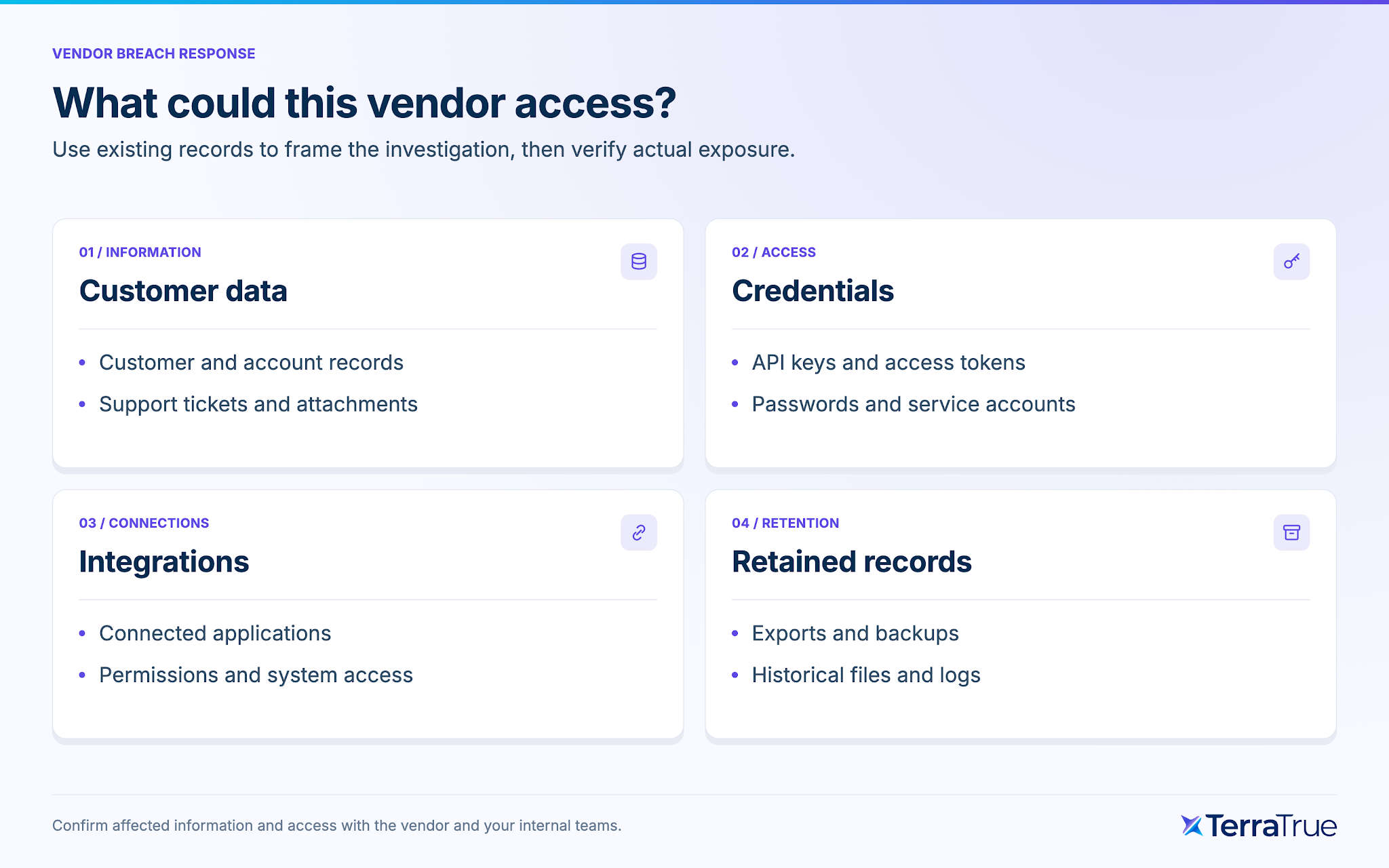
Your original vendor assessment provides a starting point. Confirm current use with the business owner and technical teams.
For example, a provider approved to receive basic account information may now process support attachments containing additional customer data. The incident investigation needs to account for that change.
What should you ask the vendor?
Send a focused request explaining the decisions your team needs to make.
Ask:
- Does the incident affect the service and environment we use?
- Which of our information, credentials, or integrations could be involved?
- What findings are confirmed, and what remains under investigation?
- What has been contained, and what exposure remains?
- What action should our organization take now?
- When will you provide the next update?
Request supporting evidence where available. Record material unanswered questions alongside their owners and follow-up dates.
Should you restrict access or stop using the service?
Security and the service owner working with Legal and the Leadership team should evaluate containment options against the suspected exposure and operational consequences.
Depending on the facts, appropriate action could include rotating credentials, restricting an integration, pausing a data transfer, or temporarily disabling access.
Immediate disconnection may reduce exposure, but it can also interrupt critical operations. Record why the chosen action is appropriate, who authorized it, and what new information would change the decision.
Some decisions cannot wait for the final investigation report. Identify those decisions early and establish what evidence is needed to act.
Who needs to be notified?
Bring Legal into the response early to assess potential obligations to customers, individuals, regulators, and other parties.
Requirements depend on the information involved, your organization’s role, applicable jurisdictions, the incident, and contractual commitments.
Separate two questions:
- Did the vendor meet its obligations to notify your organization?
- Does your organization have obligations to notify someone else?
Review the contract’s actual terms: the events covered, the notification trigger, required recipients, and expected cooperation.
Record the basis for notification decisions and revisit them as material facts change.
When should you reassess the vendor?
Reassess when the incident introduces evidence that could change the approval decision or the conditions attached to it.
Suppose an investigation reveals that a provider retained customer exports longer than your assessment recorded. The follow-up should address the retention practice, affected information, and evidence needed to verify remediation.
Your team may need to update data-flow records, revisit assessment findings, request corrective action, or establish conditions for continued use.
Assign an owner, due date, and completion requirement to each action.
This ongoing attention is consistent with NIST CSF 2.0, which includes suppliers in incident planning, response, and recovery and addresses supplier risk throughout the relationship. See NIST’s supply-chain risk guidance.
Make existing diligence useful during an incident
A vendor review becomes more valuable when the information remains available after onboarding.
Keep ownership, data relationships, contacts, assessments, and approval conditions current. Scheduled reassessments help maintain that foundation; an incident may require attention before the next scheduled review.
Related reading: Zero-Touch TPRM: Automating Vendor Diligence from Procurement to Re-Assessment.
In TerraTrue, Privacy Central helps teams investigate recorded relationships between vendors, products, data types, and related reviews. Those records can guide exposure questions; incident evidence establishes what was actually affected. Explore Privacy Central.
Connect the alert to a clear next action
A vendor breach creates questions about exposure, access, and responsibility. Current records and clear ownership help your team move into the investigation with useful context.
TerraTrue’s vendor breach notifications help teams learn about vendor incidents and follow up using the risk information already in their program.
To see how that fits into your vendor review process, Book a demo.
